Guest lecture by Mariya Petrova at Bauhaus Universität Weimar
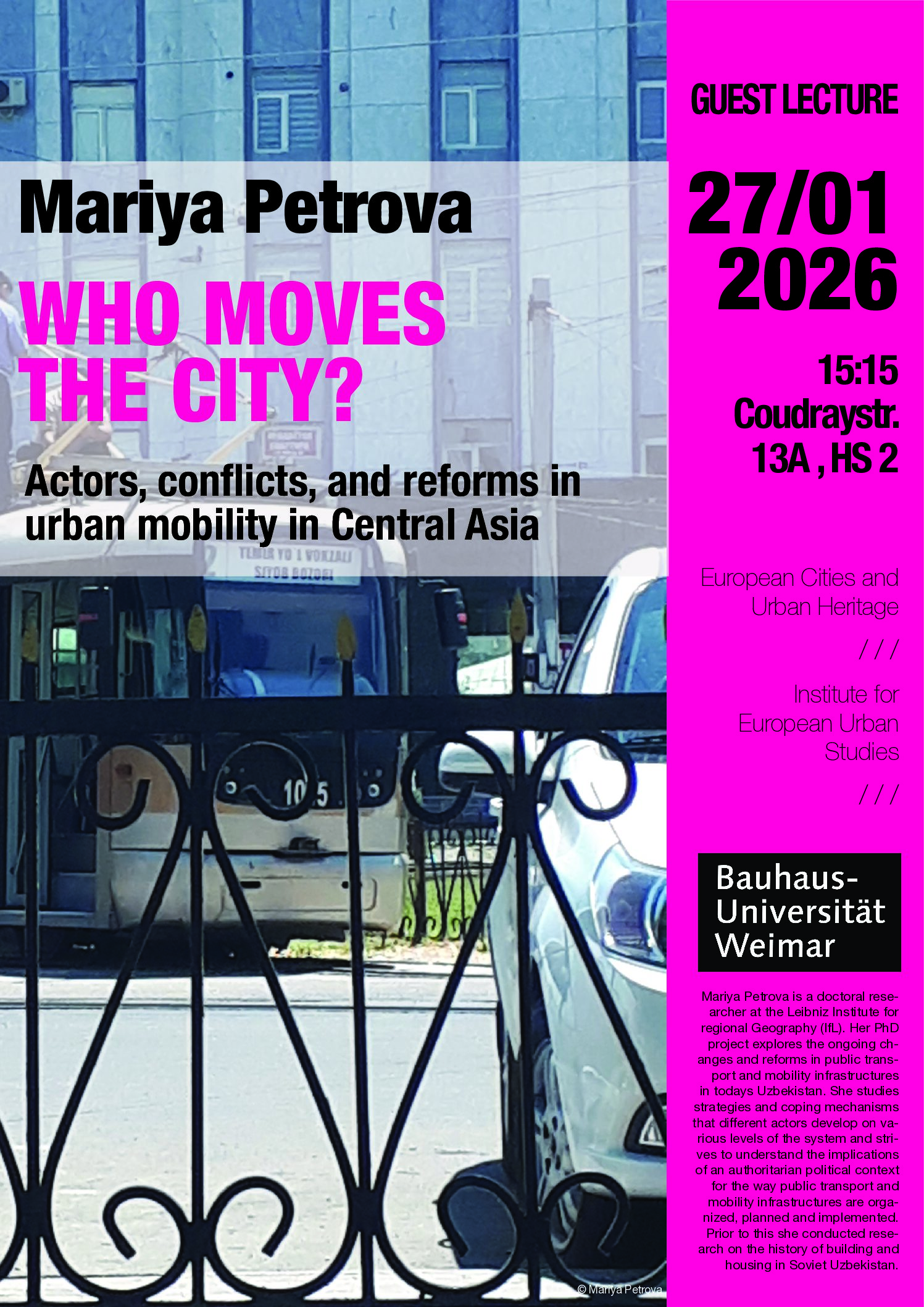
27.01.2026
15:15; Coudraystr. 13A, HS2
Institute for European Urban Studies, Bauhaus Universität Weimar
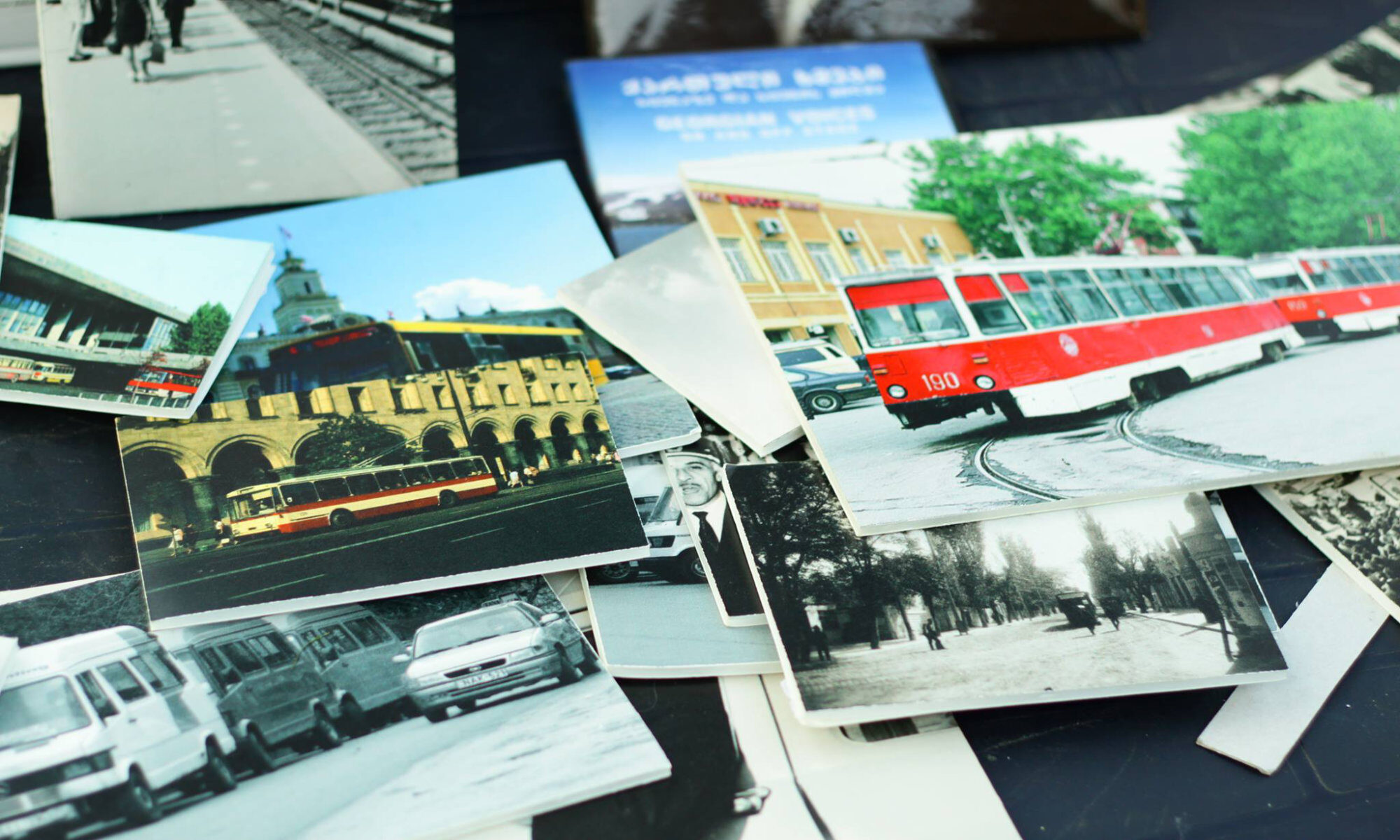
Rapid urbanisation and population growth, decades of neglected public transport and an increasing number of cars make urban mobility to a daily struggle for many citizens and pose major challenges for the cities in todays central Asia. Since the dissolution of the soviet Union the condition of urban mobility infrastructures in the region followed common patterns: from disinvestment, privatisation and informalisation in the 90-s, car-oriented development in 2000s to recent modernisation efforts, intensively supported by international developmental credits and fuelled by global imaginaries of urban modernity.
After a broad overview, Mariya Petrova’s talk will focus on the example of Uzbekistan – to illustrate the multiple challenges of mobility reforms in the context of authoritarian political culture. Her aim is to provide a critical perspective on the way how global developmental agendas intersect with local political realities and vested interests of decision makers. Finally, using case studies on transport workers and transport planners, Petrova will show how people working in the system navigate complex power relations and informalities and how these dynamics shape mobility infrastructures.
The lecture is open to the public and is held in context of the lecture series “European Cities” at Bauhaus Universität Weimar.
Find more information on here: https://www.uni-weimar.de/de/architektur-und-urbanistik/professuren/european-cities-and-urban-heritage/