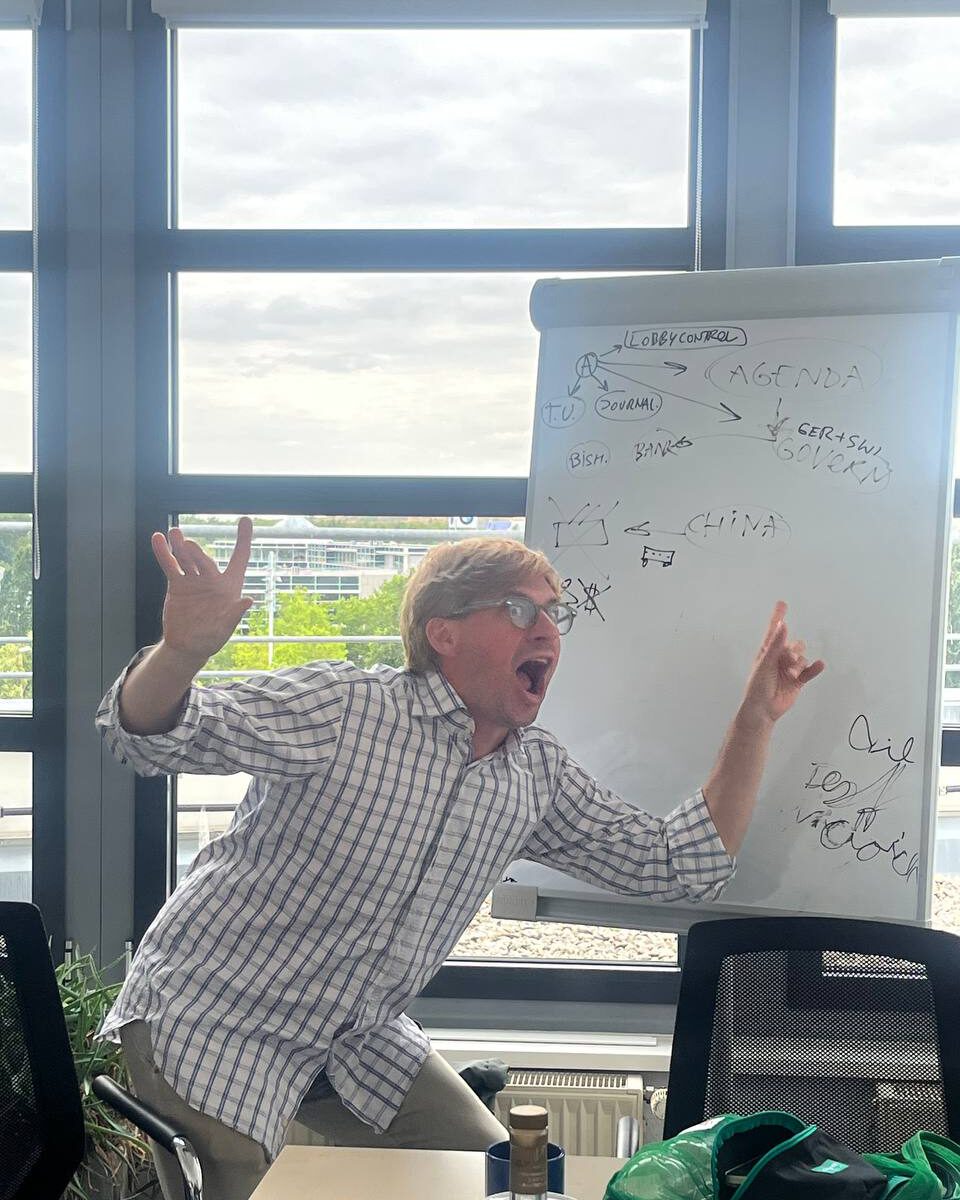
On June 30th the CoMoDe team at Leibniz-IfL organized a policy event in Brussels with the main topic “Sustainable mobility transitions: Learning from the East”. The inspiration for the event came from two research projects ongoing at the IfL: CoMoDe and MOBI-DIG and the need to build connections between the academia and policymakers.
Continue reading “Looking back on Brussels”Sustainable mobility transitions: Learning from the East?
06/29/2026 – 06/30/2026, Brussels
Registration for the Policy Event on 30 June is now open.
The Leibniz-IfL event stems from two major projects in the area of mobilities research (Leibniz competition-funded CoMoDe and MSCA-funded MOBI-DIG). It aims to bring together a range of critical knowledge and expertise on mobility transformations in studies of policies in the EU, and formerly socialist countries beyond its borders. The projects highlight the need to rethink sustainability in new terms that prioritise social responsibility of projects implemented by the EU and break with the superficial “sustainability fix”. The prevailing faith in solely technical innovation too often leads to unequal spread of funds and neglect of existing infrastructures. Responding to these tendencies it is particularly important to bring the sustainable mobility transitions closer to policy making in European countries and on the EU level.
During the two-day event we want to present and discuss the learnings from outside of the core EU regions, and pay special attention to existing solutions and strategies that can be adapted in the EU to make institutional, political and financial mechanisms truly working towards socially and environmentally just transformations of cities and regions.
Continue reading “Sustainable mobility transitions: Learning from the East?”Workshop and policy event: Sustainable mobility transitions: Learning from the East. Brussels 29-30 June 2026
We would like to invite you to Brussels on the 29th and 30th June 2026 for a workshop, followed by a policy event, on
Sustainable mobility transitions: Learning from the East
The Leibniz-IfL event stems from two major projects in the area of mobilities research (Leibniz competition-funded CoMoDe & MSCA-funded MOBI-DIG). It aims to bring together a range of critical knowledge and expertise on mobility transformations in studies of policies in the EU, and formerly socialist countries beyond its borders.
The projects highlight the need to rethink sustainability in new terms that prioritise social responsibility of projects implemented by the EU and break with the superficial “sustainability fix”. The prevailing faith in solely technical innovation too often leads to unequal spread of funds and neglect of existing infrastructures. Responding to these tendencies it is particularly important to bring the sustainable mobility transitions closer to policy making in European countries and on the EU level.
During the two-day event we want to present and discuss the learnings from outside of the core EU regions, and pay special attention to existing solutions and strategies that can be adapted in the EU to make institutional, political and financial mechanisms truly working towards socially and environmentally just transformations of cities and regions. The focus of the workshop will be on how results from research projects have been and can be used to influence policy on the EU, national and local level.
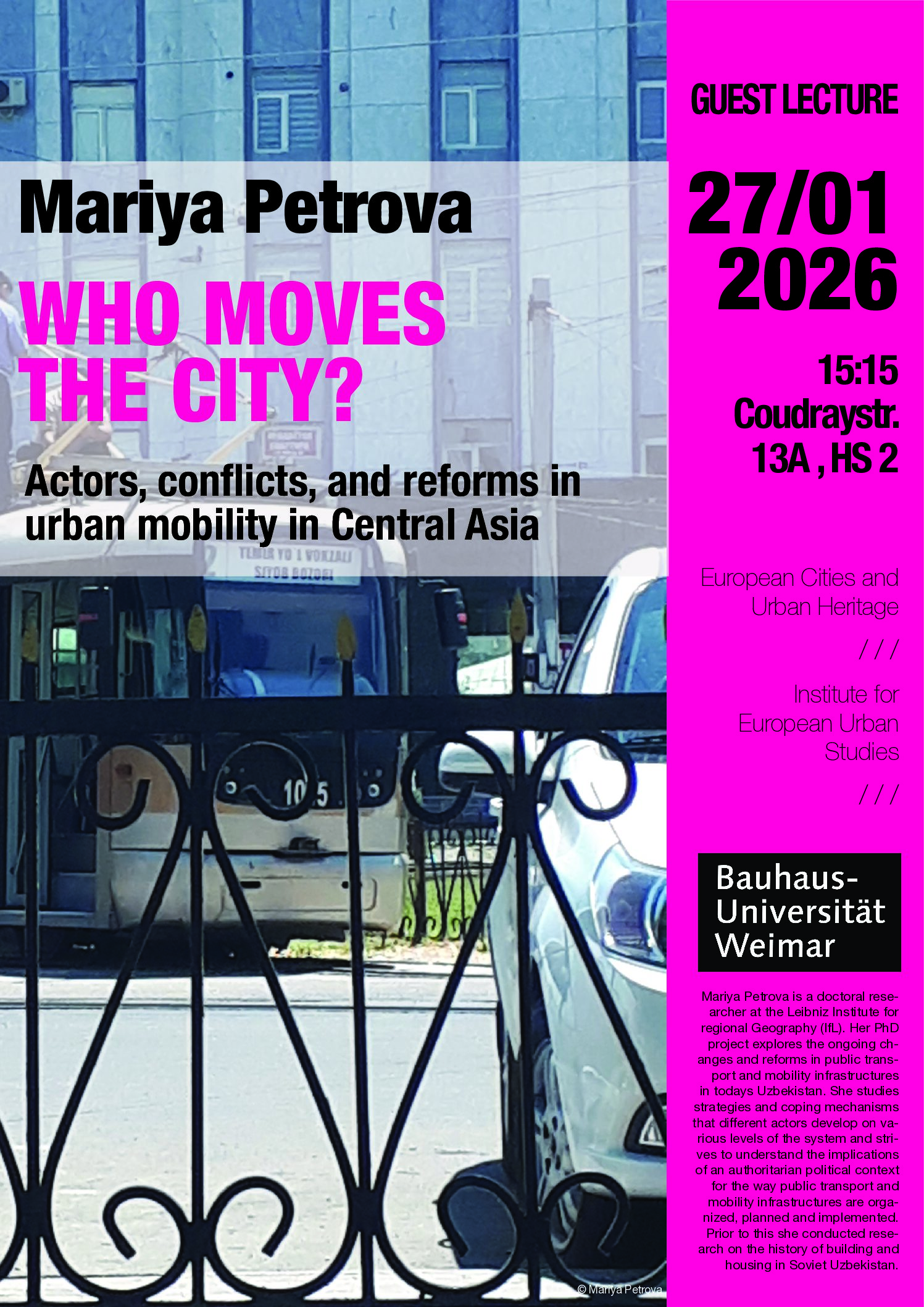
Continue reading “Workshop and policy event: Sustainable mobility transitions: Learning from the East. Brussels 29-30 June 2026”Upcoming lecture: “Who Moves the City? Actors, Conflicts, and Reforms in Urban Mobility in Central Asia”
Guest lecture by Mariya Petrova at Bauhaus Universität Weimar
27.01.2026
15:15; Coudraystr. 13A, HS2
Institute for European Urban Studies, Bauhaus Universität Weimar
Rapid urbanisation and population growth, decades of neglected public transport and an increasing number of cars make urban mobility to a daily struggle for many citizens and pose major challenges for the cities in todays central Asia. Since the dissolution of the soviet Union the condition of urban mobility infrastructures in the region followed common patterns: from disinvestment, privatisation and informalisation in the 90-s, car-oriented development in 2000s to recent modernisation efforts, intensively supported by international developmental credits and fuelled by global imaginaries of urban modernity.
Workshop on financing sustainable transitions in Central Asia
Last Tuesday on the 8th of July, the CoMoDe group hosted a workshop organised by our dear fellow Bermet Borubaeva. We had a quite diverse number of participants with very various backgrounds in presence and online. In the beginning Bermet shared her year-long experience of resisting a debt-driven sustainable transition in Bishkek’s public transport system, which ultimately resulted in the city having no sustainable transport. We discussed various ways of organising protests, mapped all the relevant stakeholders, and brainstormed novel ways of presenting the issue. The event went very well, and Bermet cooked us a fabulous plov for dinner afterwards.
Read more about the developments in Bishkek and local activist structures on: https://bishkeksmog.info/2025/06/05/ifl/
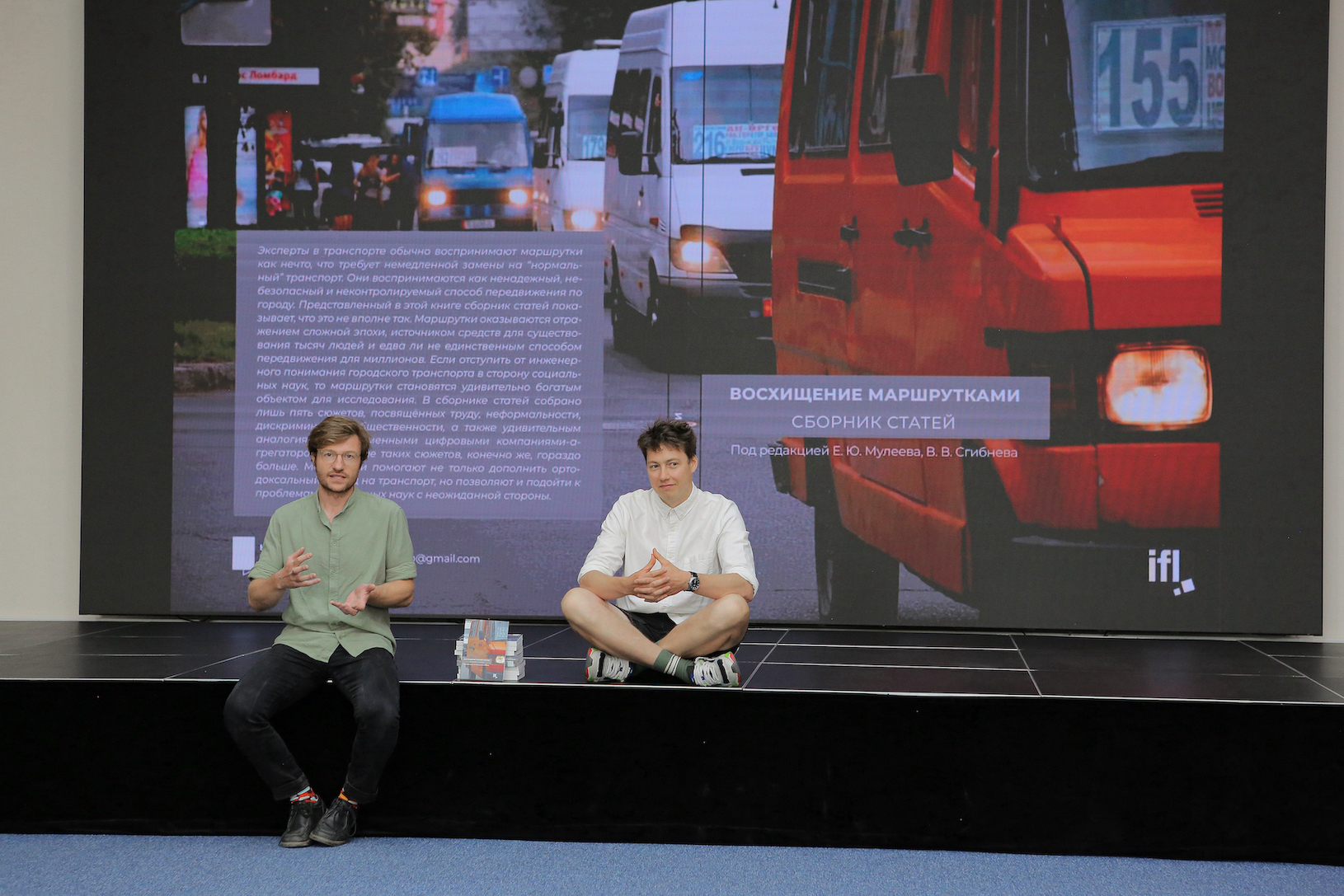
Book Launch of “Appreciation of Marshrutkas” at CASNiG Conference 2025
During the 6th annual CASNiG Conference (Central Asian Studies Network) in Bishkek, organised by the American University in Central Asia and the French Institute for Central Asian Studies, Wladimir Sgibnev and Egor Muleev presented a new, upcoming book with the name “Appreciation of Marshrutkas”. It is a collection of articles originally published in English as part of the Marshrutka project, which have now been translated into Russian. The book contains five papers by Cholpon Turdalieva, Lela Rekhviashvili, Wladimir Sgibnev and Tonio Weicker. Egor Muleev translated and edited the papers, and wrote an introduction. The day before the launch at the conference, the Bishkek-based publishing house “Books for Development” held a similar event in their bookstore. So there were two launches, and both went really well.
Seminar: Mapping Mobility Transition in Central Asia: Sustainability, Power and International Financial Institutions (Bishkek trolleybus case study)
Tuesday 8 July, 16:00, room 407.
Schongauerstraße 9, Leipzig
Leibniz Institute for Regional Geography (IfL), Leibniz-Institut für Länderkunde
Visiting Fellows Programme – 2025
The CoMoDe project, ‘Contentious Mobilities: Rethinking Mobility Transitions through a Decolonial Lens (CoMoDe)”
The IfL Visiting Fellowship Programme, ‘Mobility Transition in Central Asia: Sustainability, Power and International Financial Institutions (IFIs)’, will focus on the case of Bishkek’s wasted trolleybus system, which was once the most sustainable form of transport in the city. In recent years, public concern has grown over rising levels of air pollution in Bishkek. According to IQAir, an air quality information platform, Bishkek often ranks among the world’s most polluted cities. In an attempt to address this issue, Bishkek City Hall, in collaboration with the Asian Development Bank (ADB), intends to purchase 120 electric buses to replace the trolleybuses that were financed by a loan from the European Bank for Reconstruction and Development (EBRD).
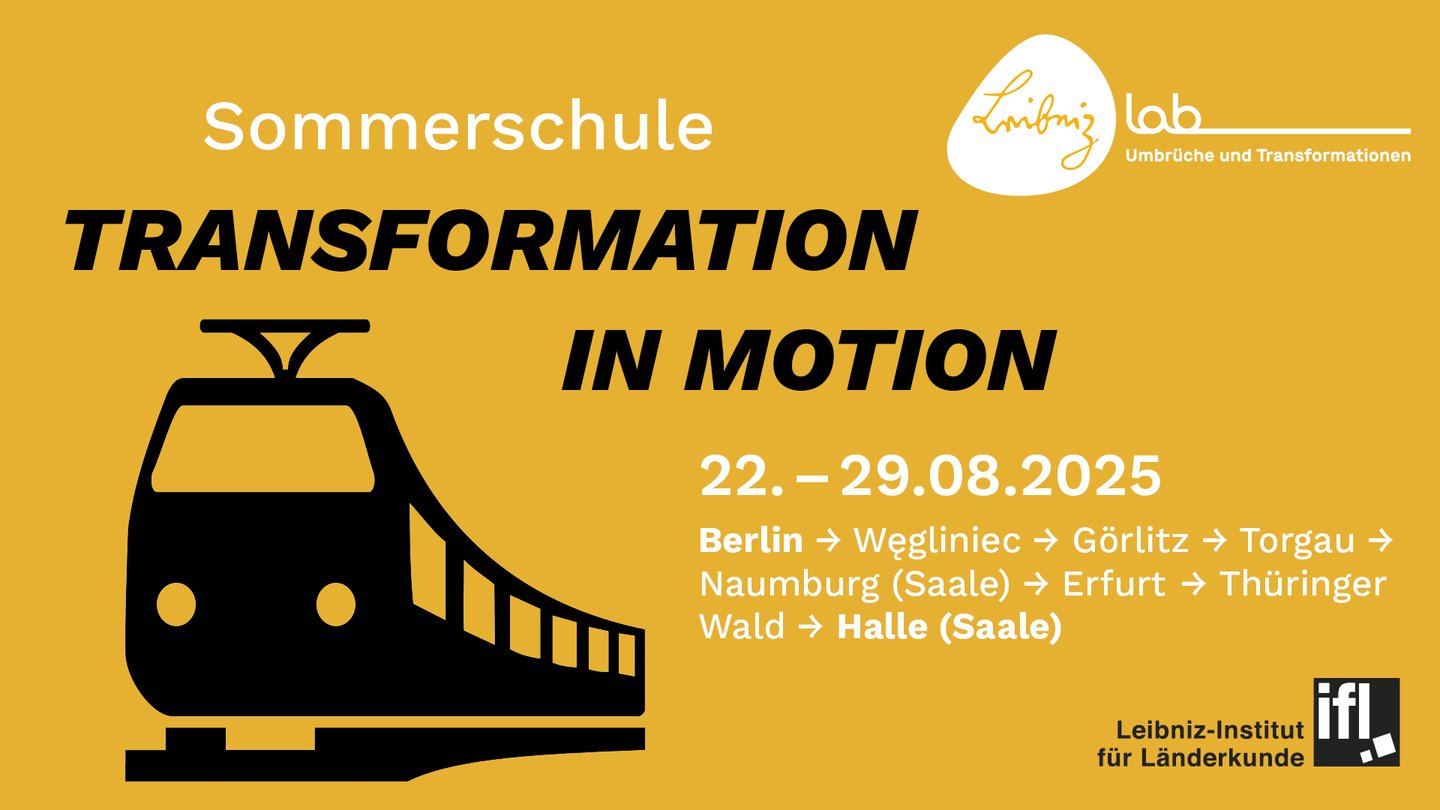
Continue reading “Seminar: Mapping Mobility Transition in Central Asia: Sustainability, Power and International Financial Institutions (Bishkek trolleybus case study)”Open Call for the „Transformation in Motion“ summer school
The Leibniz Institute for Regional Geography (IfL) invites researchers, students, media and art professionals to take part in a one-week train journey through transformation regions in East Germany and Poland. Applications are open until 15 June 2025.
The summer school entitled ‘Transformation in Motion’ starts on 22 August 2025 in Berlin. The route leads via Węgliniec, Görlitz, Torgau, Naumburg (Saale), Erfurt and the Thuringian Forest and ends in Halle (Saale) on 29 August 2025. The journey along past and present borders is intended to offer participants a deeper insight into the social, economic and ecological changes that are summarised under the term transformation. The focus will be on phenomena such as structural change, transport and climate issues, cultural initiatives and specific aspects of urban and regional development.
Continue reading “Open Call for the „Transformation in Motion“ summer school”Meet Mariya Petrova and Dr. Wladimir Sgibnev at “Book-A-Scientist” 2025!
At “Book a Scientist” on 3 June 2025, anyone who is curious and thirsty for knowledge will have the opportunity to talk to an expert from the Leibniz Association for 25 minutes and ask everything they have always wanted to know about their favourite topic.
You can now book your discussion with a Leibniz scientist. To do so, click on one or more dates of your choice on the event website and fill in the corresponding booking form. The individual, 25-minute one-to-one meetings will take place online on 3 June 2025 between 10 and 11 am and 4 and 5 pm. The offer is free of charge.
All topics and dates can be found here:
https://www.leibniz-gemeinschaft.de/ueber-uns/neues/veranstaltungen/book-a-scientist
Mariya Petrova
Transport reforms in Uzbekistan: a view from the inside
After years of cuts and stagnation, Uzbekistan has recently started investing in the modernisation of public transport and mobility infrastructure in general. However, the process is characterised by complex social and political conflicts and hurdles: Shortage of skilled labour, authoritarian political culture, the (vested) interests of decision-makers. What are the perspectives of the people working at the various levels of the system
Mariya Petrova is a researcher in the Mobilities & Migration research group focussing on infrastructures in the (post-)Soviet space.
Dr. Wladimir Sgibnev
Mobility in rural areas: perspectives and strategies for coping with everyday life
Everyday mobility in peripheral areas requires solutions that go beyond “urban” concepts. The widespread unease of being dependent on one’s own car is an important signal for discussions on the mobility turnaround. What seems realistic is a mix of local supply, coordinated or on-demand public transport services and – in the medium term – probably also the car.
Dr Wladimir Sgibnev coordinates the IfL research group ‘Mobilities and Migration’ and deals with issues of mobility in peripheral areas, among other things.
Open Calls for T2M, CATference and CASNiG 2025 out now!
The CoMoDe group is pleased to share open calls for three events that are important to us: the upcoming T2M, CATference and CASNiG conferences. As part of our team will be present, we would be happy to hear from you about organising joint sessions and panels.
Continue reading “Open Calls for T2M, CATference and CASNiG 2025 out now!”